
Credential Proxy architecture
A user asks an Agent, “Implement a feature and push a branch.” OpenClaw Enterprise (OCE) runs the Agent in a sandbox. The Agent runs ordinary Git commands. OCE keeps the GitHub App signing key and the installation token outside that sandbox.
From the user to GitHub
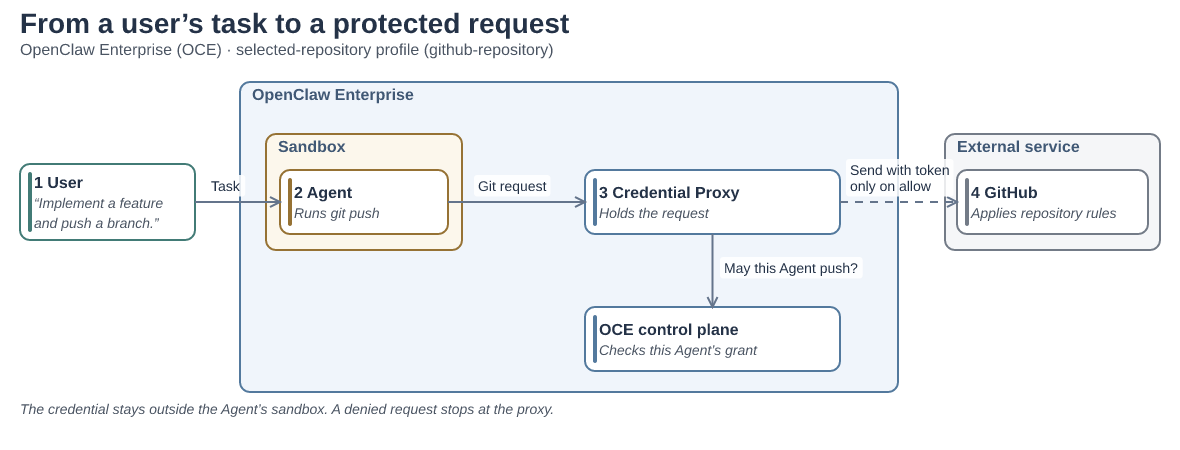
This example uses the selected-repository profile (github-repository). The operator chooses which repositories the Agent can use. The Credential Proxy checks the request against that grant through the control plane. If OCE denies the push, the proxy stops it. If OCE allows it, the proxy adds the credential and GitHub applies its own repository rules.
How does the Credential Proxy authorize a Git request?
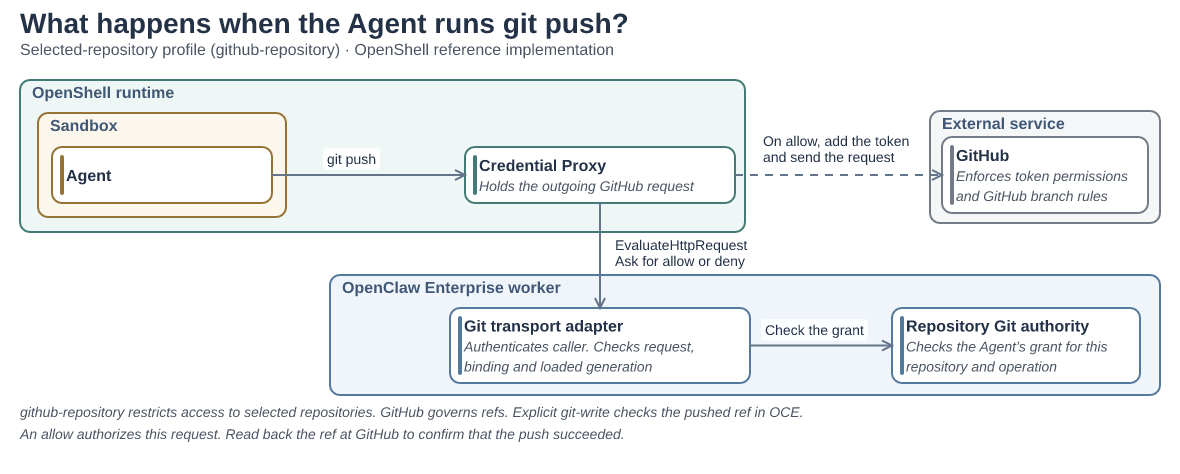
In the OpenShell implementation shown here, the supervisor acts as the Credential Proxy. Its EvaluateHttpRequest hook sends the attempted request to the OCE worker. The worker checks who called, which credential version the proxy loaded, and whether the grant covers this operation.
For selected repositories, the grant names repositories on one GitHub App installation. GitHub enforces the token's permissions and branch rules. An exact-ref write grant also checks the pushed ref. The opt-in installation-wide preview can accept a registration without the required binding fields. In that case, the startup probe shows that the hook ran once. It cannot establish that every later request must use it. The hook's allow reply authorizes the observed request. To find out whether a push succeeded, read back the ref from GitHub. See OpenShell repository access.
How does the token get there?
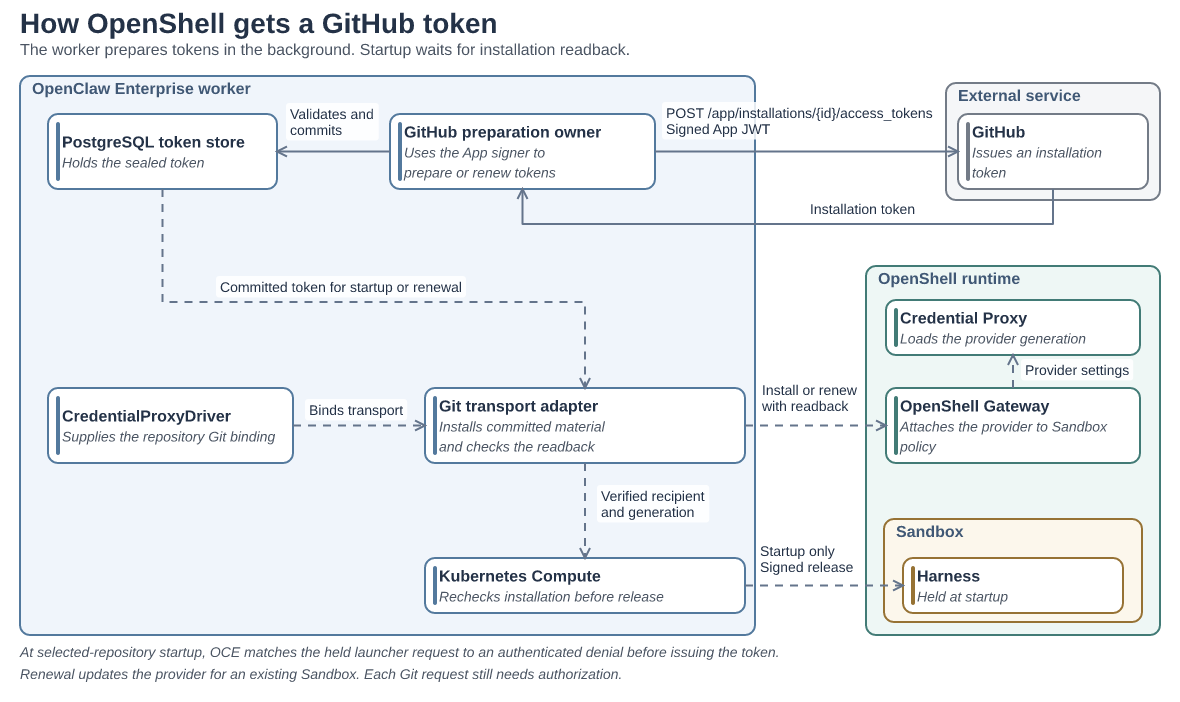
One OpenShell Backend supplies both SandboxDriver and CredentialProxyDriver. The worker binds its ProtectedRepositoryGitAuthority through bindRepositoryGit. See the Driver contract.
The worker signs an App JWT and sends it to GitHub in a POST /app/installations/{installation_id}/access_tokens request. GitHub returns an installation token. The worker validates its scope and expiry before committing it to the store. The transport adapter reads that committed token through the Repository Git authority. Preparation and refresh run separately from Git requests. On the selected-repository path, OCE checks the held launcher's request against an authenticated middleware denial before issuing credentials. Credential installation and signed release precede Agent startup. See OpenShell enrollment and token renewal.
Who controls a generic API request and its reply?
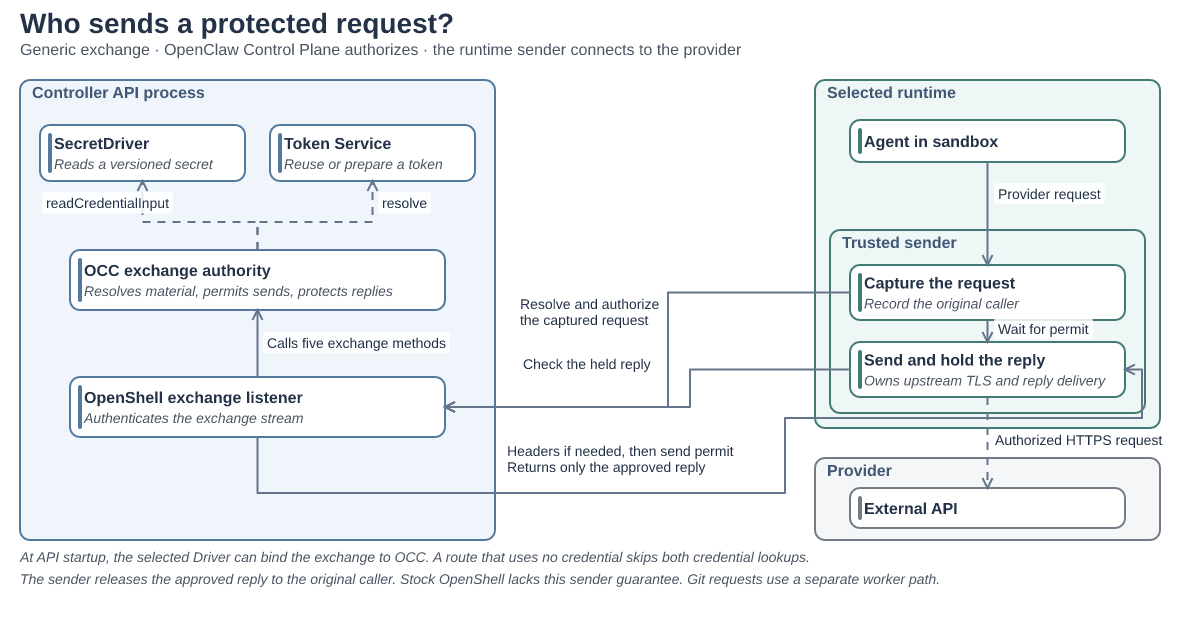
For a GitHub metadata read, OCC asks Token Service for a token after it authorizes the request. Token Service can reuse a usable token or start or join issuance for that grant. A qualified sender can ask OCC to resolve a credential, recheck permission just before sending, and protect the complete response before releasing it to the caller. The OpenShell Git hook above returns a decision for a token the supervisor already holds. Walk through a GitHub metadata request.
For the proposed alternative to installing Git credentials through the Gateway, see the Git credential pull design discussion.